
Three papers. One closed diagnostic loop.
Systems do not fail because they are complex. They fail because they are misclassified.
A three-paper sequence diagnosing recurring failure across platforms, institutions, and self-correcting systems.
Together they move from mismatch between signalled and consumed capability, to collapse through function fusion under consequence, to the missing redesign layer that internal correction loops cannot reliably produce.
All three papers are now available on SSRN as preprints.
Read in sequence, starting with Paper 01.
Recurring system failure is often misread because the wrong layer is being named. Systems may appear to fail because of workload, complexity, shortage, bad actors, or poor execution.
The deeper pattern is structural: mismatch between signal and optimisation, collapse of irreducible functions at the point of consequence, and absence of a legitimate redesign layer upstream of execution and diagnosis.
Each paper introduces one diagnostic instrument. Together they form a closed loop.
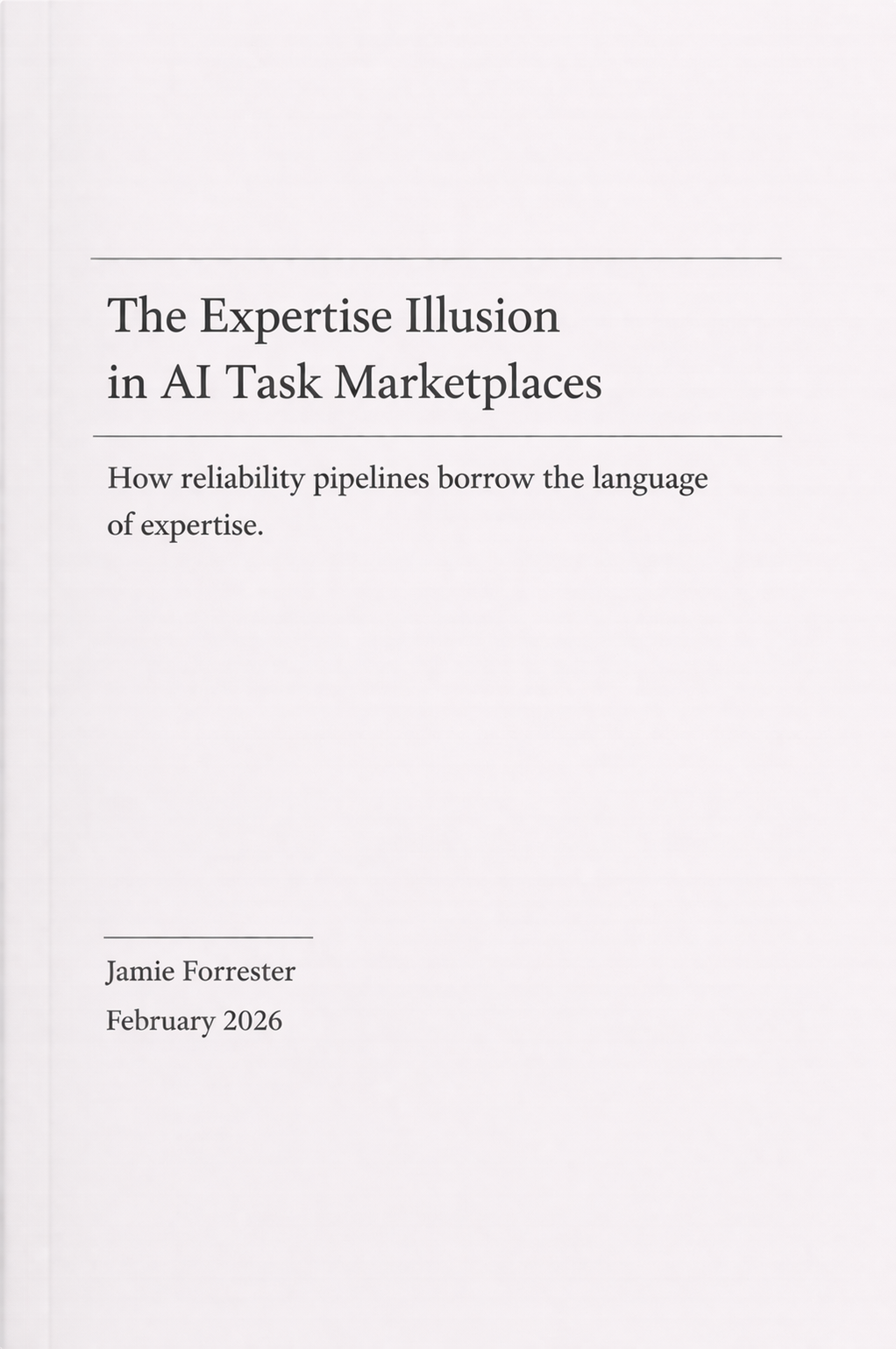 Preprint on SSRN
The Expertise Illusion in AI Task Marketplaces
Diagnostic instrument: Interface-legitimacy mismatch
How reliability pipelines borrow the language of expertise and create a structural mismatch between signalled capability and consumed capability.
The interface signals one thing. The operating logic consumes another. The gap between them is where the failure lives — structural, not incidental, and therefore recurring.
Compare what the system signals in its interface with what it optimises for in execution. When they diverge, the failure is structural.
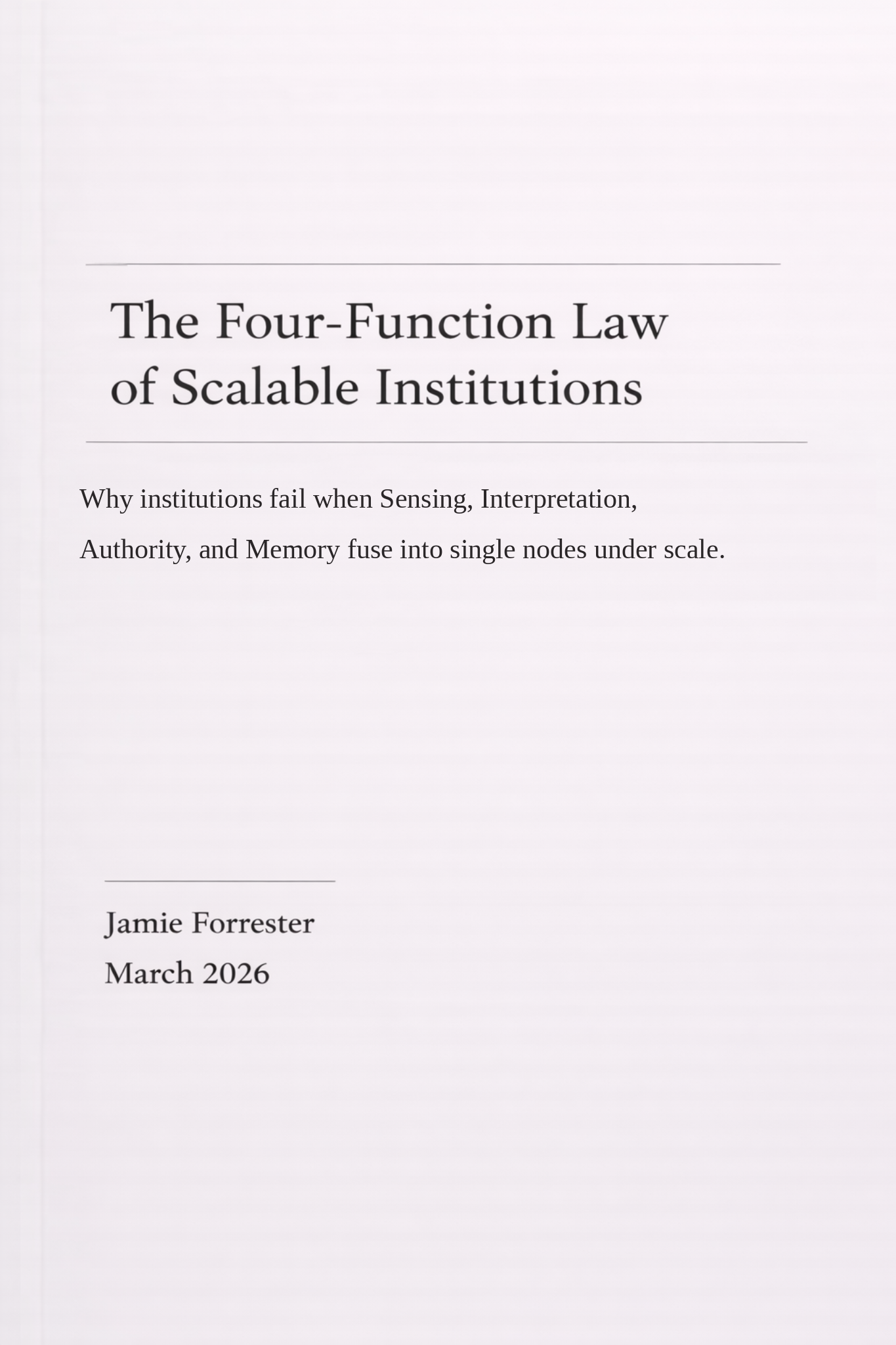 Preprint on SSRN
The Four-Function Law of Scalable Institutions
Diagnostic instrument: Four-Function Law — Sensing · Interpretation · Authority · Memory
Establishes the Four-Function Law of Scalable Institutions. Every institution performs four irreducible functions: Sensing, Interpretation, Authority, and Memory. The law is not that these functions exist — it is what happens when they remain fused at the same human node under ambiguity and consequence.
Collapse is not a risk at that point. It is the structural outcome. What the institution calls burnout, shortage, or overload is the visible surface of a hidden allocation error — and it recurs across reform cycles because the topology is never examined.
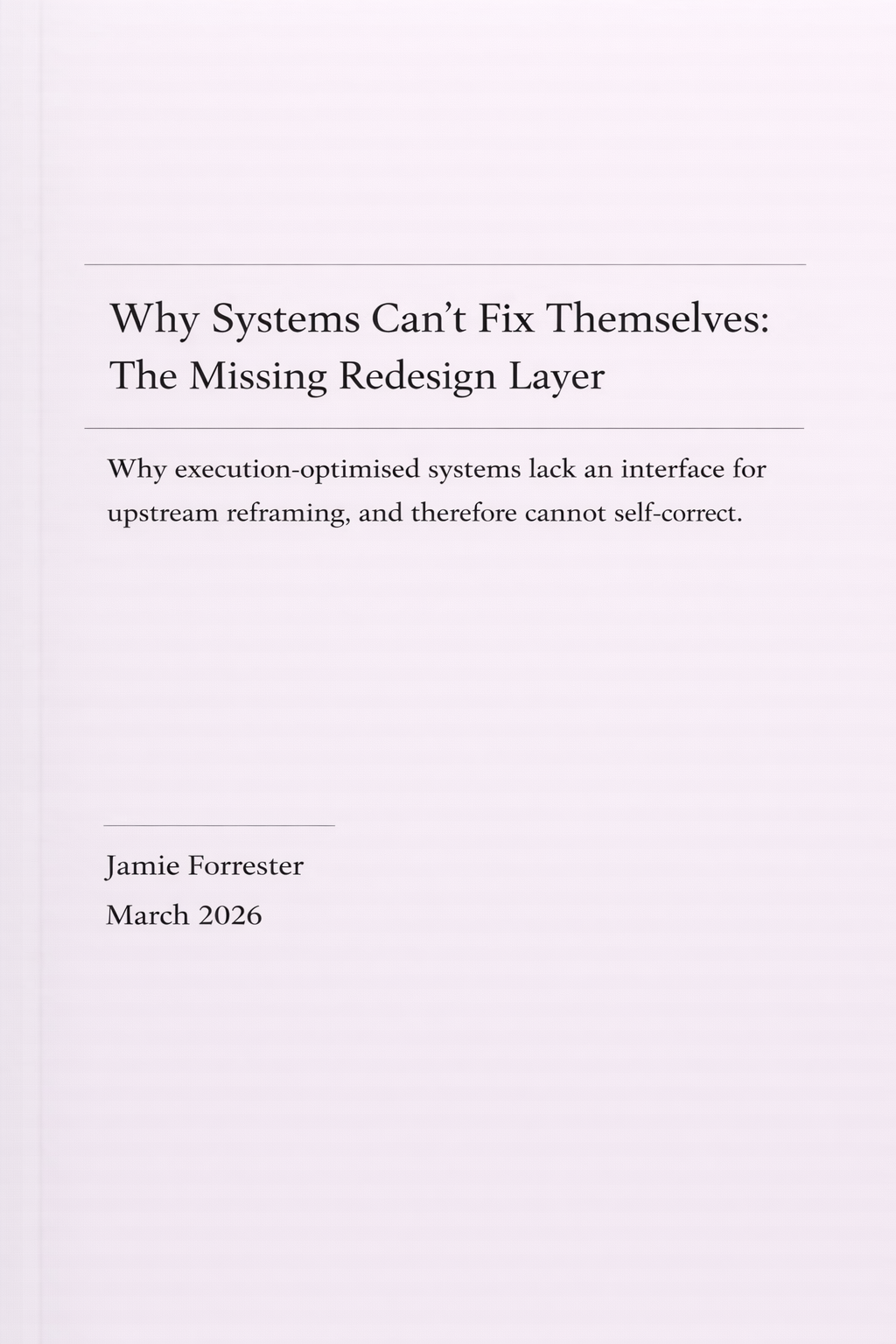 Preprint on SSRN
Why Systems Can't Fix Themselves: The Missing Redesign Layer
Diagnostic instrument: The redesign layer — the upstream layer absent by default in most self-correcting systems
Introduces the Redesign Law and correction collapse. Distinguishes execution, diagnosis, and redesign, and shows why the first two cannot reliably produce the third from within the same correction loops.
A system cannot redesign a frame its correction loops are built to preserve. Redesign requires a layer upstream of both execution and diagnosis — and that layer is absent by default in most systems.
Mismatch
Shows that systems can signal one thing while consuming another. The interface and the operating logic are not aligned. The gap is structural.
Collapse
Shows how institutional burden concentrates when irreducible functions remain fused at the point of consequence. Reform cycles do not hold because the topology is never changed.
Missing redesign
Shows why the systems producing these failures cannot reliably redesign themselves. The correction loops optimise the wrong layer. The redesign layer is absent by default.
The trilogy does not just describe three failure modes. It explains why they form a sequence: mismatch produces the conditions for collapse; collapse confirms the absence of a legitimate redesign layer; and the missing redesign layer ensures the cycle repeats.
Seeing all three together is what makes structural diagnosis possible rather than mere symptom description.
The trilogy is the entry point
The trilogy is the public entry point into a wider research program. That program extends the diagnostic sequence into family substitution as institutional shadow systems, a taxonomy of institutional primitives, a grammar of system design, and the wider mapped research programme.
The papers also feed directly into the diagnostic practice. The diagnostic logic behind the written artifacts is grounded in the same structural laws — not assembled per engagement.