
When the same failure keeps returning, the problem is no longer execution. It is structure.
I write fixed-scope structural artifacts for founders, operators, and decision owners who need the architecture exposed or a recurring failure structurally diagnosed. Three paths from £2,000. Diagnosis first. Redesign only from a locked diagnostic frame. Start with contact or the five-line brief.
The same failure costs more the second time than the first. At some point the structure has to be named.

Jamie Forrester
Independent Systems Architect
Edinburgh, Scotland
I study why complex systems fail, then diagnose, redesign and build better ones.
That work has produced a diagnostic taxonomy of 9 failure classes and 54 subtypes, a growing research programme, the Seeing Systems books, and a series of software ventures built from the same structural principles.
- ✓The same failure keeps returning under different names
- ✓Internal fixes have not held — the correction loop is missing the real break
- ✓The team cannot agree on what is actually breaking
- ✓Builders are inventing design decisions during implementation
- ✓Workarounds have become part of the operating model
- ✓The visible symptom is downstream of a rule, boundary, or primitive mismatch
- ✗You need code debugging or a technical audit
- ✗You need live incident response
- ✗You need implementation ownership or delivery
- ✗You need generic strategy advice
- ✗The failure is one-off or already diagnosed
- ✗The diagnosis is known and you only need delivery
Nine failure classes. 54 subtypes. Every recurring structural failure fits somewhere.
When you send the five-line brief, it is run against the Diagnostic Taxonomy — a classification system developed alongside 10 published papers and refined through three public proof sets. The taxonomy identifies which class of failure is producing the recurring break, and which subtype is the specific mechanism. That classification governs the engagement path, the diagnostic frame, and the correction sequence.
Systems do not fail randomly. They fail in recognisable structural patterns — across sectors, scales, and domains. The taxonomy makes that pattern visible before any diagnosis begins.
Three paths. Fixed scope. No hourly rates.
Start with a Structural Lens Brief when you need the architecture extracted. Use the Diagnostic Artifact when the failure must be named. Use Full Structural Engagement when the correction sequence must be specified.
Commissioned separately, diagnosis and redesign total £35,000. As one governed sequence, £25,000. Full service details →
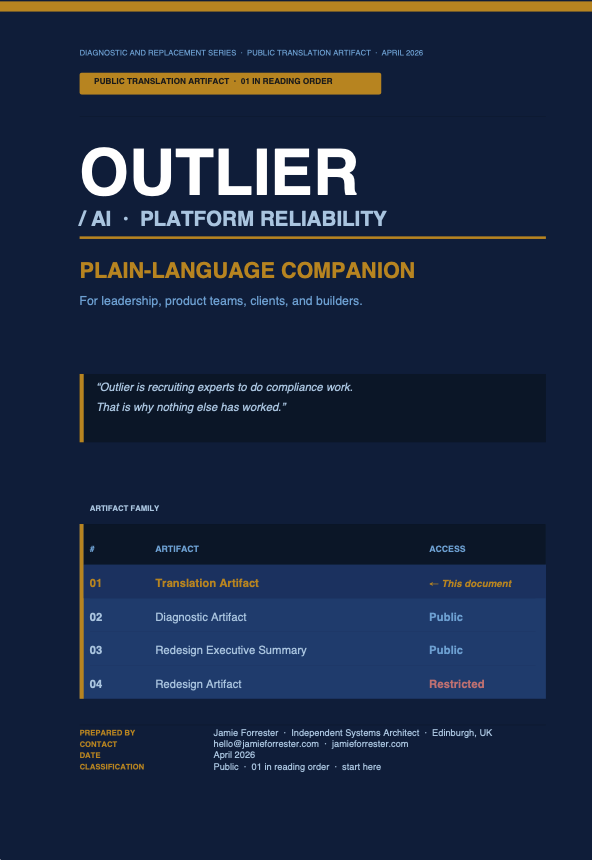
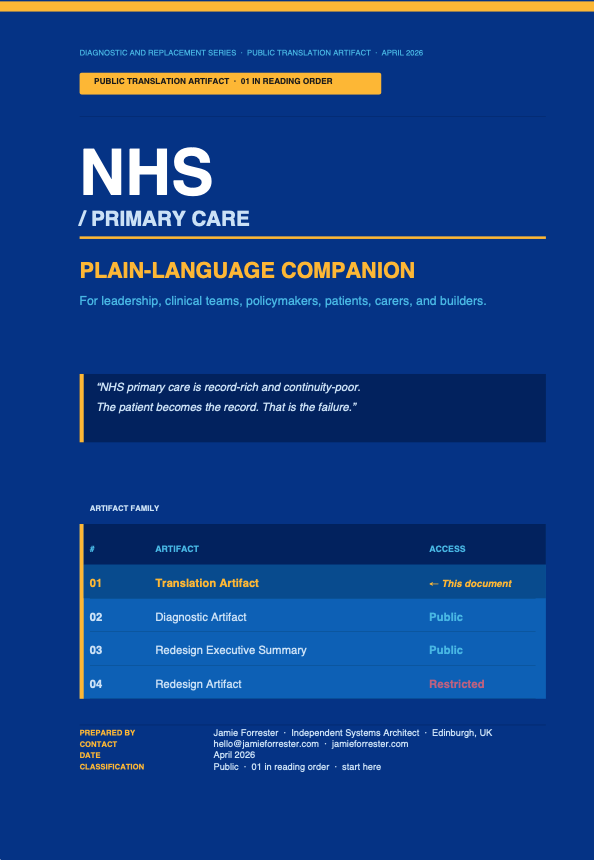
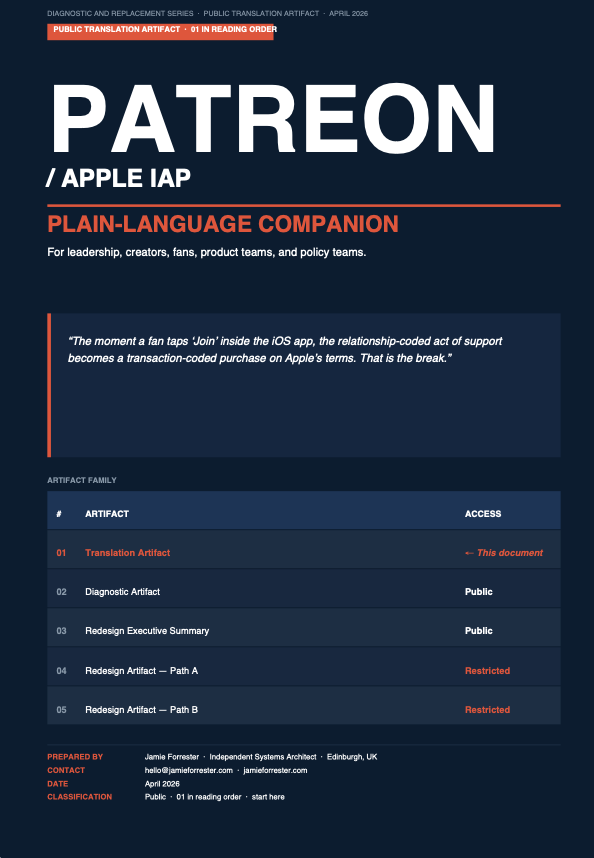
Three systems. Same method. Public proof it repeats.
Self-screen before sending a brief.
Four questions. Answer them honestly and you will know whether the failure is structural, and where to look first. Use this as a first-pass fit check before briefing.
Send the repeated failure. Not the proposed fix.
The five-line brief. No diagnosis yet. Just the signal.
Start with the right entry — contact me or request a Structural Lens for architecture extraction; send the five-line brief for a recurring failure.
I review fit and confirm the right fixed scope. No one moves to redesign without diagnosis first.
You receive the agreed artifact — Structural Lens Brief, Diagnostic Artifact, or the full four-artifact sequence.
- 01What keeps going wrong?
- 02What is it costing? Money, time, trust, load, or drift.
- 03Where does it show up? Teams, roles, systems, or touchpoints.
- 04What has already been tried?
- 05What cannot change? Non-negotiables and constraints.
If the work is not the right fit, I will say so.
The clearest entry into the research: three papers that move from mismatch, to collapse, to the missing redesign layer.
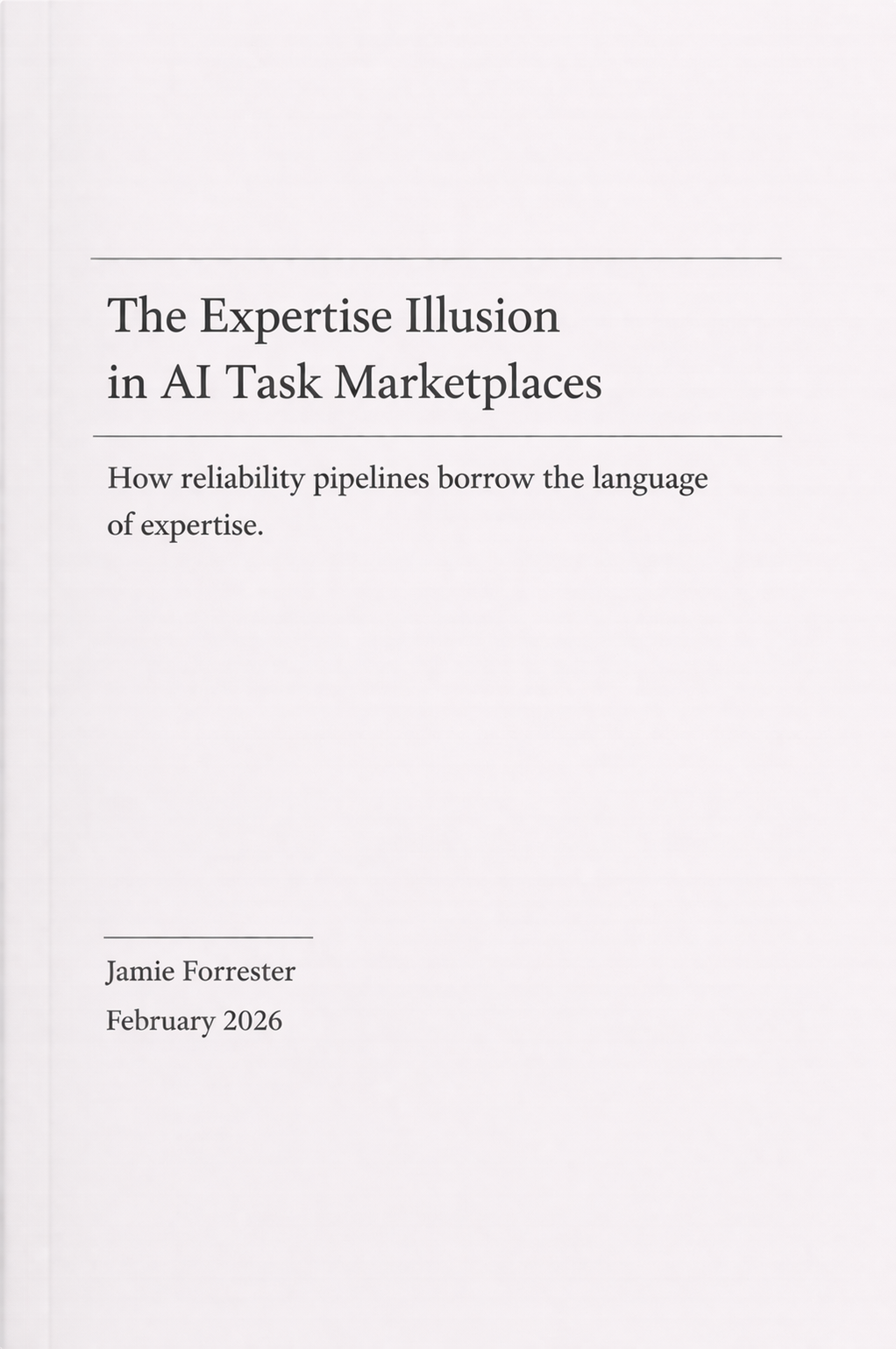 Published paper 01
The Expertise Illusion in AI Task Marketplaces
Diagnostic instrument: Interface-legitimacy mismatch
How reliability pipelines borrow the language of expertise and create a structural mismatch between signalled capability and consumed capability.
View paper → Published paper 02
The Four-Function Law of Scalable Institutions
Diagnostic instrument: Four-Function Law — Sensing · Interpretation · Authority · Memory
Establishes what happens when sensing, interpretation, authority, and memory remain fused at the same human node under ambiguity and consequence.
View paper → Published paper 03
Why Systems Can't Fix Themselves: The Missing Redesign Layer
Diagnostic instrument: The redesign layer — the upstream layer absent by default in most self-correcting systems
Introduces the Redesign Law and correction collapse, showing why execution and diagnosis cannot reliably produce redesign from inside the same correction loops.
View paper →Ten papers are published and free to read. The complete Diagnostic Taxonomy is available on request. Together they sit inside a 59-paper research programme that is already mapped.



For publishers and literary agents: proposals, sample chapters, manuscripts and sequence materials are available for serious enquiries.
PUBLISHING ENQUIRY →Send the repeated failure. Not the proposed fix.
If you already know what keeps recurring, send the five-line brief. If you simply want to open a conversation first, contact me directly.
If the case is not structural, I will say so.