
NHS Primary Care Continuity
Independent public proof of the structural method applied to primary-care continuity.
Produced independently from public evidence. Not commissioned by the NHS, NHS England, or DHSC.
Proof of structural capability, not contracted outcomes.
NHS Primary Care Continuity System
Public healthcare institution · National Health Service (UK)Replace fragmented institutional memory with a patient-held operational continuity system: portable continuity record, symptom event layer, Consultation Packet, outcome append, emergency access, carer access, and recognition pathway.
Produced independently from public evidence. Not commissioned by the NHS, NHS England, or DHSC.
Plain-language entry point. Creates shared understanding of the patient-record failure and the continuity redesign.

Entry point: No prior knowledge required. Designed to create a shared structural read across clinical, policy, and operational teams before moving to the full diagnostic evidence.
Best for leadership, clinicians, patients, carers, policymakers, and first-time readers.
Evidence-tiered diagnosis. Names the continuity-poor failure, locates the collapse node, and separates operational memory from audit trace.
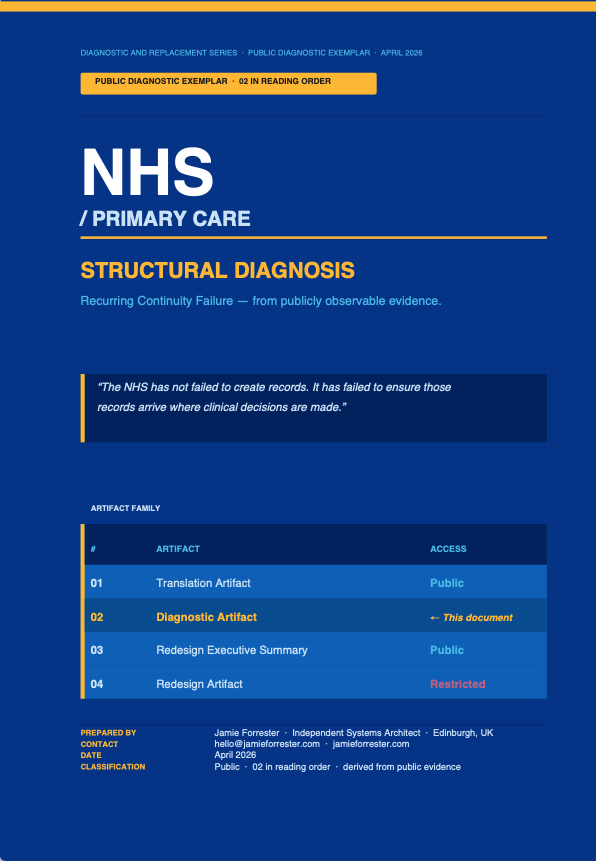
Public-evidence boundary preserved.
Governing diagnosis: NHS primary care is record-rich and continuity-poor. Operational memory is not structurally present at the point of clinical consequence.
Primitive mismatch: promised joined-up care; actual organisation-held records, after-the-fact sharing, and patient memory as the default continuity mechanism. The system generates more data about patients than at any prior point. Less of it arrives, in retrievable form, at the moment a decision must be made.
Best for evidence review, policy framing, clinical leadership, and understanding the governing diagnosis.
Board-level replacement logic. Shows the patient-held continuity architecture, proof standard, and consequence of deferral.
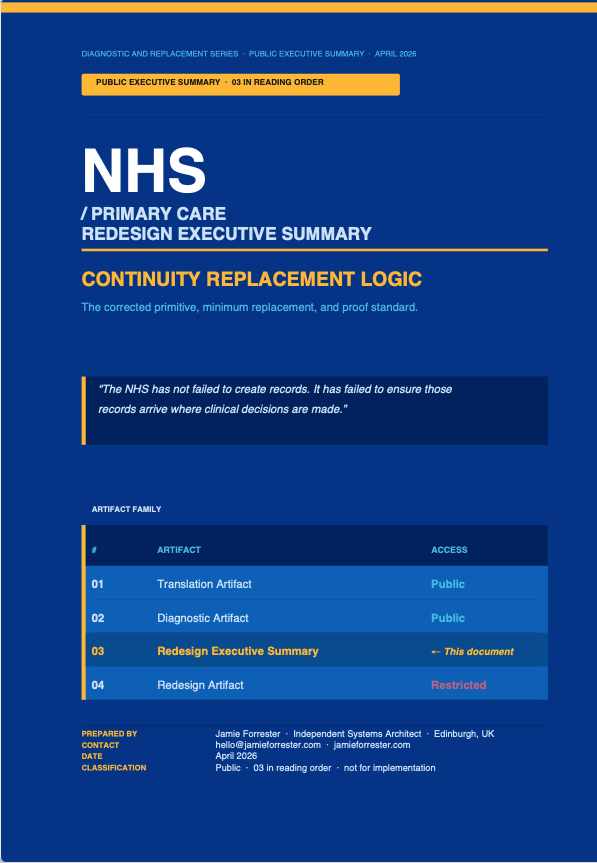
Replacement rule: patient-held ≠ patient-burdened. Includes fake-progress tests, proof standard, and consequence of deferral.
Best for policy leads, executives, clinical leaders, commissioners, and decision owners.
Complete replacement specification.
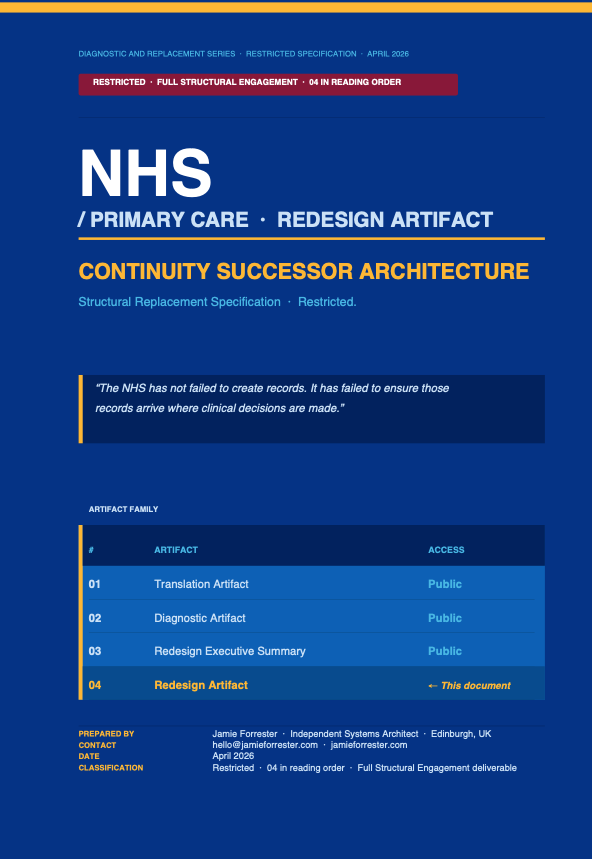
Turns the public replacement logic into a governed build sequence: seven-move transition sequence, truth-kernel schema, custody / hosting / authority separation, invalid continuity states, source-of-truth hierarchy, emergency and carer access, refusal invariants, admissibility conditions, recapture gates, pilot rules, and builder handoff.
The public Redesign Executive Summary shows the replacement logic. The Full Redesign Artifact is the restricted specification delivered in a Full Structural Engagement.
Access reviewed by context. The full specification is not a public download.